((Article by Prof. Dr.Mohammad Dawood Mousa, Center for Strategic Studies / Department of Futures Studies and Crisis Management))...
((Article by Prof. Dr.Mohammad Dawood Mousa, Center for Strategic Studies / Department of Futures Studies and Crisis Management))...
Venezuela After Maduro: A Study in Transformation and Fragmentation
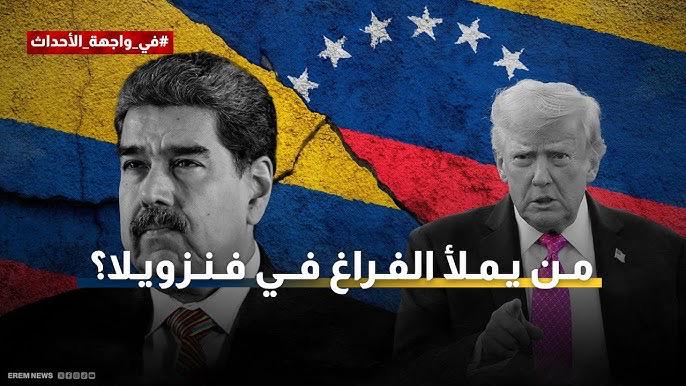
Venezuela has entered a critical phase in contemporary Latin American history, marked by the arrest of Nicolás Maduro by U.S. elite forces and his subsequent transition from head of state to defendant before the U.S. judiciary. This event extends beyond a mere military or security operation; it signals a profound shift in the concepts of statehood, sovereignty, and legitimacy, at a time when modern regimes have sought to present themselves as stable and unassailable.
The events in Caracas illustrate the intersection of historical dynamics and hegemonic pressures, highlighting the tensions between a fragmented state structure and international actors shaping the conditions for survival. This situation reflects not just the fall of an individual leader but the collapse of a political system built on centralized economic dependence and extreme personalization of authority, where the facade of the state disintegrated even before the leader himself was removed.
Political Realism as an Analytical Framework
Understanding this transformation requires a political realist approach, which emphasizes power as it exists rather than as it ideally should be. The decline of the Venezuelan regime was gradual, stemming from accumulated structural weaknesses: the erosion of state institutions, their capture by local elites, and the dismantling of formal economic governance in favor of partisan or tribal logics. Consequently, the state functioned primarily as a mechanism for elite preservation rather than as an institution serving the population.
Political realism transcends normative evaluation and focuses on the interests of actors, conflict mechanisms, and the real constraints of political action, grounding analysis in observable dynamics of power and influence rather than in idealized notions of governance.
U.S. Hegemony and Venezuela’s Post-Maduro State
The United States sought to manage the crisis by framing it within its strategic interests, particularly regarding energy security and regional stability. However, the implications extend beyond immediate concerns: the intervention represents a redefinition of Venezuelan sovereignty through strategic control over its primary resource—oil.
The announcement that Venezuela would continue supplying oil to the U.S. indefinitely indicates that control has shifted from purely military dominance to encompass economic and strategic influence. In this emerging global energy order, resources function as instruments of geopolitical leverage, as major powers compete for access to critical assets.
Simultaneously, the operation exposed deep domestic divisions between those who perceive U.S. intervention as liberation from authoritarianism and those who view it as an imposition on national sovereignty.
Legitimacy, Political Vacuum, and Transitional Prospects
A central question arises: what constitutes legitimacy in Venezuela today? It is not solely derived from coercive authority but rather emerges from a combination of:
• Popular support, long marginalized under the previous regime;
• Functional state institutions, which, despite systemic decay, have not entirely collapsed;
• The social and economic welfare of ordinary citizens, reflecting the state’s capacity to meet basic needs.
Failure to integrate these elements risks merely replacing one power structure with another, rather than establishing a functional state capable of meaningful operation within the evolving global system.
Potential Scenarios in the Near Term
1. Gradual Transition to Civilian-Democratic Governance:
An internal coalition could form a legitimate transitional government, potentially leading to constitutional reform, free elections, and reconstruction of state institutions. Success would require addressing militia activity, internal security challenges, and redefining power relations under a unified legitimate authority.
2. Armed Conflict and Structural Fragmentation:
Should internal actors fail to reach consensus and armed groups assert influence, Venezuela could face a cycle of sustained violence and prolonged instability, echoing historical precedents where both the regime and state apparatus collapsed concurrently.
Statehood and Sovereignty in an Internationalized Context
Venezuela’s case is distinguished by the interaction of domestic dynamics with transformations in the global system. Contemporary international politics is no longer merely a negotiation among leaders wielding force; it is a complex network connecting state institutions, economies, civil society, and global structures.
From a political realist perspective, Maduro’s fall represents not just the removal of a leader but a redefinition of the state itself, caught between the model of an independent sovereign entity and that of a state reshaped by external influence.
Conclusion: From Disintegration to the Crossroads of Reconstruction
Venezuela’s current paradox lies not in the removal of an individual but in the transformation of the state itself: the collapse of a centralized, failing system versus the potential establishment of a new political order transcending internal authoritarianism and redefining genuine popular sovereignty.
If legitimacy derives from the lived experiences of citizens, Venezuela’s challenge is not simply the transfer of power but the reconstruction of governance structures that integrate individual ambitions and political institutions into a cohesive national framework, rather than one dominated by foreign influence or armed factions
Topics may interest
A Sweet Whisper on World Dhad Day((Migration and Refugees in the Middle East / Article by Dr. Widad Hammad Al-Fahdawi)
A strategy for preserving water from wasting in light of climate change
International Women's Day: Feats and Pride
Migration in Reverse
The role of universities in countering extremism and building peace in Iraqi society
Ramadan is the spur of inspiration, not inaction and laziness
Examples of tribal fanaticism in Islamic history and its impact on peaceful coexistence